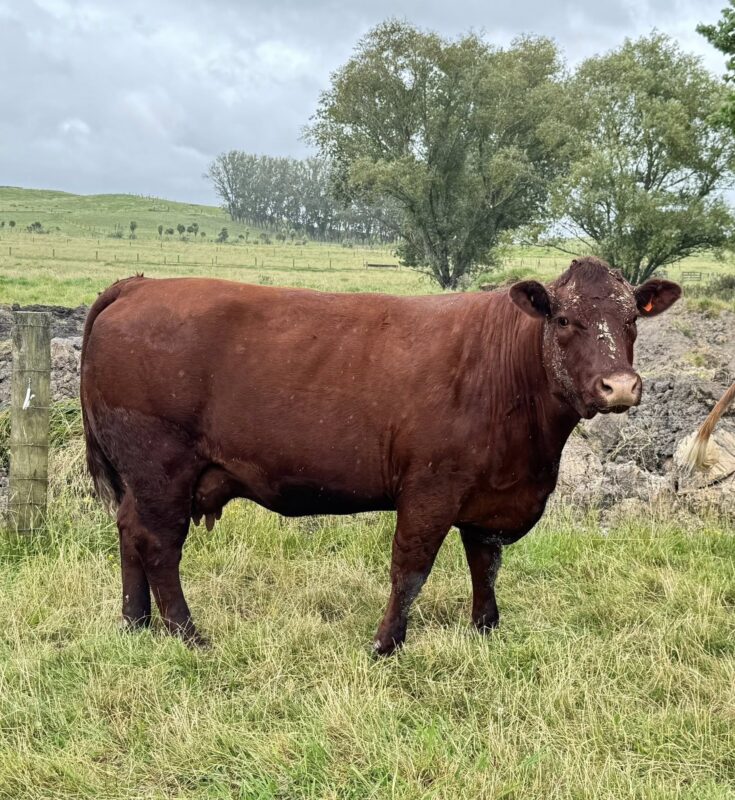
When you travel to the other side of the world, a visit to a Salers herd is too good an opportunity to miss. That opportunity came through Ian McNaughton, who kindly led me to Karen Woolley. Conveniently based just outside Auckland, and with my route taking me from Gisborne in that direction a few days later, the timing felt less like coincidence and more like inevitability.
Willow Creek, NZ: Karen and Bruce Woolley’s Salers story, built on the Pacey legacy
On the rolling country around Wellsford, north of Auckland, Karen Woolley does not talk about cattle as “stock” for long. They quickly become individuals. That combination of close stockmanship and hard commercial realism has shaped Willow Creek, a family farming business now run by Karen and her husband Bruce, assisted by Sarah Thomas, and built on the foundations laid by Karen’s late father, David Pacey, and her mother, Cheryl.
Today, Willow Creek operates as a diversified farming enterprise, combining a large-scale dairy unit, a beef finishing system, lamb finishing operation, a quarry and a pedigree breeding programme incorporating Salers, Simmental and Angus cattle. Breeding priorities are firmly commercial: fertility, calving ease and temperament sit at the core. While the focus remains squarely on the cattle at home, the show ring is used as a shop window.
Karen’s grounding came from a household where pedigree cattle mattered, and decisions were judged over years rather than seasons. David Pacey’s influence is still evident in how cattle are assessed: not simply on appearance, but on how they calve, how they mother, how they hold condition, and how their progeny perform when conditions tighten.
The home farm extends to 106 hectares, supported by a further 105 hectares of leased land nearby. These rented blocks are not short-term additions; they are secured on 20-year agreements, giving the business confidence to plan grazing, finishing and breeding strategies.
The enterprise mix is deliberately broad. Alongside cattle, the Woolley’s also buy in around 200 lambs annually, adding another layer of flexibility to the system, and the business also runs a quarry and machine hire operation. During the summer months, when time allows, Karen can often be found operating a tractor and scoop and keeping machinery moving.
While the Salers and beef enterprise attracts attention, the backbone of the business is a substantial Jersey-based dairy herd of around 100 cows. Calves from the dairy system are supplemented with bought in dairy calves, bringing annual numbers to approximately 160–170 head. Around 75% are sold at 100–110kg liveweight, with the remainder retained and finished on the farm.
Finished beef cattle are taken efficiently through to processor weights of around 440kg in approximately 16 months. Performance is driven largely off grass, supported by silage and hay, with minimal reliance on bought-in inputs.
The Salers herd currently sits around 30 head, and Karen is clear about why the breed continues to earn its place. She points to its commercial strengths: ease of calving, strong maternal ability, good milk production, and a level of fertility that allows heifers to calve at two years of age as a routine expectation rather than an occasional success.
That focus on functional maternal traits also explains why Salers genetics are sought after beyond Willow Creek. As Karen explains, she often sells Salers bulls as a “solution bull” for heifers. Most are placed within dairy herds or continental terminal sire herds, aiming to calve heifers at two, but lacking the genetic base themselves to do so. Salers bulls are introduced to provide that capability, improving system efficiency and supporting long-term profitability. At Willow Creek, calving at two, it is regarded as standard practice rather than an aspirational benchmark.
Breeding decisions at Willow Creek are tightly aligned with commercial outcomes. Fertility sits at the top of the agenda. Karen’s policy is unequivocal: she will not sell a bull that cannot get cows in calf within the first three weeks. The reasoning is straightforward. Compact calving windows produce more uniform groups, simplify feed management, and underpin overall system profitability.
Temperament is actively selected, not excused. Karen is realistic, she said “reputations, once formed, are slow to fade!”. Her response has been firm selection and uncompromising culling. Any animal that does not handle well is removed from the breeding programme, regardless of its genetic merit on paper.
The use of AI and purchased semen is equally deliberate. With genetic options currently limited, Karen is now planning to introduce embryo work. This will allow the key traits she values to be preserved while broadening the genetic base. To date, the herd has been built largely around bulls including Hercules, Whiskey and Monopoly, and embryos offer a route to expand bloodlines without diluting performance.
The Woolley’s are under no illusion that showing is the financial engine of the business. It requires money, time, travel and considerable preparation. However, it also plays an important role as a marketing tool, imposes discipline within the breeding programme, and provides a public benchmark against which cattle can be measured whilst acting as a busman’s holiday.
Willow Creek has long been a familiar name on the show circuit, regularly bringing out teams of Salers across a full season and building towards the major fixtures. That reputation as the “showies from Wellsford” has not gone unnoticed, with farming media frequently noting the herds consistent presence and strong results. Showing also aligns closely with Karen’s breeding philosophy. Cattle that handle calmly, lead well, and remain settled in the pressure of a show environment are typically the same animals that deliver the temperament and manageability commercial producers want at home.
At its core, Willow Creek remains a family operation. David Pacey’s legacy and Cheryl’s steady influence continue to shape the decisions that matter most: what to keep, what to cull, what to push for, and what never to compromise on. Karen and Bruce have modernised and diversified the business, but the fundamentals remain reassuringly traditional—breed cattle that work, keep them calm, and make sure they earn their place.